模拟退火§
模拟退火是一种随机化算法。当一个问题的方案数量极大(甚至是无穷的)而且还是一个连续的非单峰函数时,我们可以使用模拟退火求解。
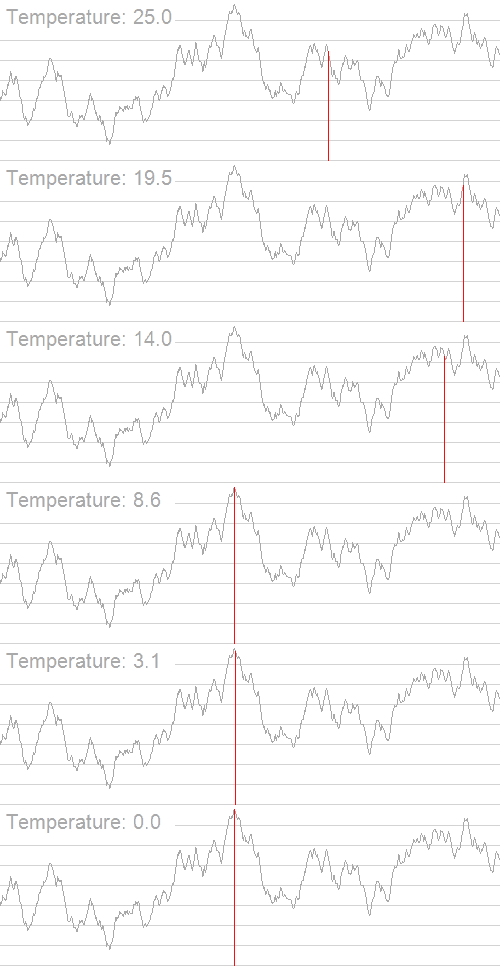
定义当前温度为 \(T\) ,新状态 \(S^{'}\) 与已知状态 \(S\) (新状态由已知状态通过随机的方式得到,随机的范围由当前温度决定,随着温度降低,随机的范围将越来越小)之间的能量(值)差为 \(\Delta E(\Delta E\geqslant 0)\) ,则发生状态转移(修改最优解)的概率为
\[\begin{split}P(\bigtriangleup E)=\begin{cases} 1,S^{'}\ is\ better\ than\ S \\ e^{\frac{-\bigtriangleup E}{T}},otherwise \end{cases}\end{split}\]模拟退火时我们有三个参数:初始温度 \(T_0\) ,降温系数 \(d\) ,终止温度 \(T_k\) 。其中 \(T_0\) 是一个比较大的数, \(d\) 是一个非常接近 \(1\) 但是小于 \(1\) 的数, \(T_k\) 是一个接近 \(0\) 的正数。
首先让温度 \(T=T_0\) ,然后按照上述步骤进行一次转移尝试,再让 \(T=d\cdot T\) 。当 \(T<T_k\) 时模拟退火过程结束,当前最优解即为最终的最优解。
注意为了使得解更为精确,我们通常不直接取当前解作为答案,而是在退火过程中维护遇到的所有解的最优值。
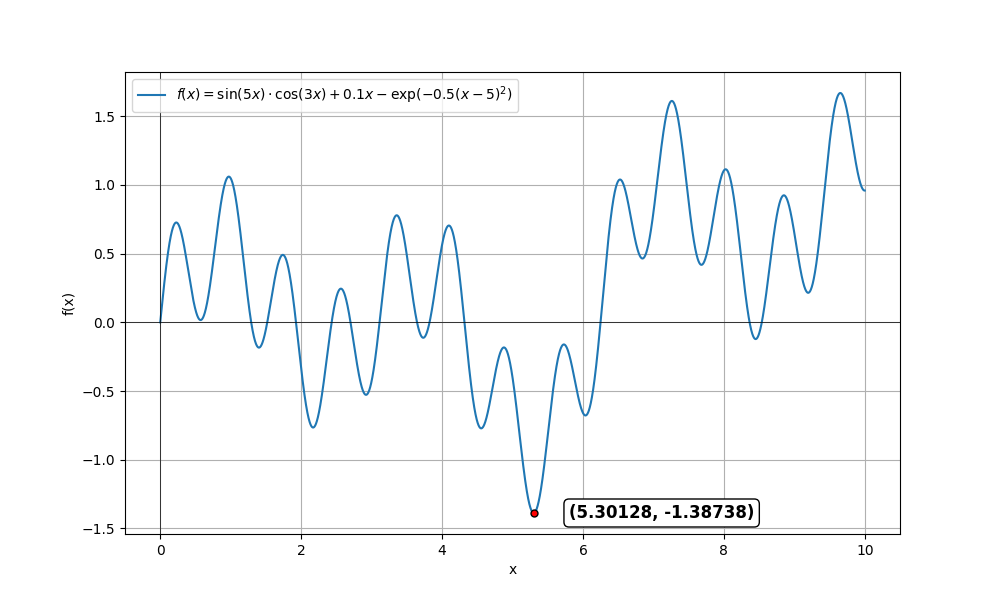
举个简单例子,我们来寻找函数 \(f(x) = \sin(5x) \cdot \cos(3x) + 0.1x - \exp(-0.5(x-5)^2)\) 在 \(0\le x \le10\) 的情况下的极小值点。
 #include <bits/stdc++.h> std::mt19937 Rand(time(NULL)); constexpr double T0 = 10., Tk = 1e-4, d = 0.9999; std::pair<double, double> ans; void limit(double& x) { x = std::max(0., std::min(10., x)); } double rand(double l, double r) { limit(l), limit(r); return l + (r - l) * (double)Rand() / Rand.max(); } double f(double x) { double res = std::sin(5 * x) * std::cos(3 * x) + 0.1 * x - exp(-0.5 * (x - 5) * (x - 5)); if (res < ans.second) ans = {x, res}; return res; }; void simulate_anneal() { double x = rand(0, 10); for (double t = T0; t > Tk; t *= d) { double y = rand(x - t, x + t); double dt = f(y) - f(x); if (exp(-dt / t) > rand(0, 1)) { x = y; } } } int main() { while ((double)clock() / CLOCKS_PER_SEC <= 0.8) { simulate_anneal(); } std::cout << ans.first << ' ' << ans.second << '\n'; return 0; }
#include <bits/stdc++.h>

std::mt19937 Rand(time(NULL));
constexpr double T0 = 10., Tk = 1e-4, d = 0.9999;
std::pair<double, double> ans;

void limit(double& x) { x = std::max(0., std::min(10., x)); }

double rand(double l, double r) {
    limit(l), limit(r);
    return l + (r - l) * (double)Rand() / Rand.max();
}

double f(double x) {
    double res = std::sin(5 * x) * std::cos(3 * x) + 0.1 * x -
                exp(-0.5 * (x - 5) * (x - 5));
    if (res < ans.second) ans = {x, res};
    return res;
};

void simulate_anneal() {
    double x = rand(0, 10);

    for (double t = T0; t > Tk; t *= d) {
        double y = rand(x - t, x + t);
        double dt = f(y) - f(x);
        if (exp(-dt / t) > rand(0, 1)) {
            x = y;
        }
    }
}

int main() {
    while ((double)clock() / CLOCKS_PER_SEC <= 0.8) {
        simulate_anneal();
    }

    std::cout << ans.first << ' ' << ans.second << '\n';

    return 0;
}
输出
5.30128 -1.38738。一些例题:
#include <bits/stdc++.h> typedef std::pair<double, double> PDD; std::mt19937 Rand(time(NULL)); constexpr double T0 = 5e3, Tk = 1e-14, d = 0.9995; int n; std::vector<std::array<double, 3>> a; PDD ans; double E = 1e18; void limit(double& x) { x = std::max(-T0, std::min(T0, x)); } double rand(double l, double r) { limit(l), limit(r); return l + (r - l) * (double)Rand() / Rand.max(); } double get_dist(PDD x, PDD y) { return std::hypot(x.first - y.first, x.second - y.second); } double calc(PDD x) { double e = 0; for (auto [X, Y, W] : a) { e += get_dist(x, {X, Y}) * W; } if (e < E) { ans = x; E = e; } return e; } void simulate_anneal() { PDD x{0, 0}; for (int i = 0; i < n; i++) { x.first += a[i][0]; x.second += a[i][1]; } x.first /= n, x.second /= n; for (double t = T0; t > Tk; t *= d) { PDD y{rand(x.first - t, x.first + t), rand(x.second - t, x.second + t)}; double dt = calc(y) - calc(x); if (exp(-dt / t) > rand(0, 1)) { x = y; } } } int main() { std::ios::sync_with_stdio(false); std::cin.tie(nullptr); std::cin >> n; a.resize(n); for (int i = 0; i < n; i++) { std::cin >> a[i][0] >> a[i][1] >> a[i][2]; } while ((double)clock() / CLOCKS_PER_SEC <= 0.8) { simulate_anneal(); } std::cout << std::fixed << std::setprecision(3) << ans.first << ' ' << ans.second << '\n'; return 0; }#include <bits/stdc++.h> template <typename T> struct Point { std::vector<T> x; int size; Point() : size(0) {} Point(int size) : x(size), size(size) {} Point(std::vector<T> v) : x(v), size(v.size()) {} T& operator[](int i) { return x[i]; } const T& operator[](int i) const { return x[i]; } Point operator-(Point y) { for (int i = 0; i < size; i++) { y[i] = x[i] - y[i]; } return y; } T norm2() { T sum = 0; for (int i = 0; i < size; i++) { sum += x[i] * x[i]; } return sum; } }; typedef Point<double> PD; std::mt19937 Rand(time(NULL)); int n; std::vector<PD> points; double S2 = 1e18; PD ans; void to_use(double& x) { x = std::max(-2e4, std::min(2e4, x)); } double rand(double l, double r) { to_use(l), to_use(r); return l + (r - l) * (double)Rand() / Rand.max(); } double calc(PD& x) { double mean2 = 0; std::vector<double> dist2(n + 1); for (int i = 0; i < n + 1; i++) { dist2[i] = (x - points[i]).norm2(); mean2 += dist2[i]; } mean2 /= n + 1; double s2 = 0; for (int i = 0; i < n + 1; i++) { double dif = dist2[i] - mean2; s2 += dif * dif; } if (s2 < S2) { S2 = s2; ans = x; } return s2; } void simulate_anneal() { PD x(n); for (int i = 0; i < n; i++) { x[i] = rand(-2e4, 2e4); } for (double t = 5e3; t > 1e-6; t *= 0.9999) { PD y(n); for (int i = 0; i < n; i++) { y[i] = rand(x[i] - t, x[i] + t); } double dt = calc(y) - calc(x); if (exp(-dt / t) > rand(0, 1)) { x = y; } } } int main() { std::ios::sync_with_stdio(false); std::cin.tie(nullptr); std::cin >> n; for (int i = 0; i < n + 1; i++) { PD point(n); for (int j = 0; j < n; j++) { std::cin >> point[j]; } points.push_back(point); } while ((double)clock() / CLOCKS_PER_SEC <= 0.8) { simulate_anneal(); } std::cout << std::fixed << std::setprecision(3); for (int i = 0; i < n; i++) { std::cout << ans[i] << ' '; } return 0; }